"The Dispossessed" Amazing Worlds in a (Not-so) Sci-fi Novel
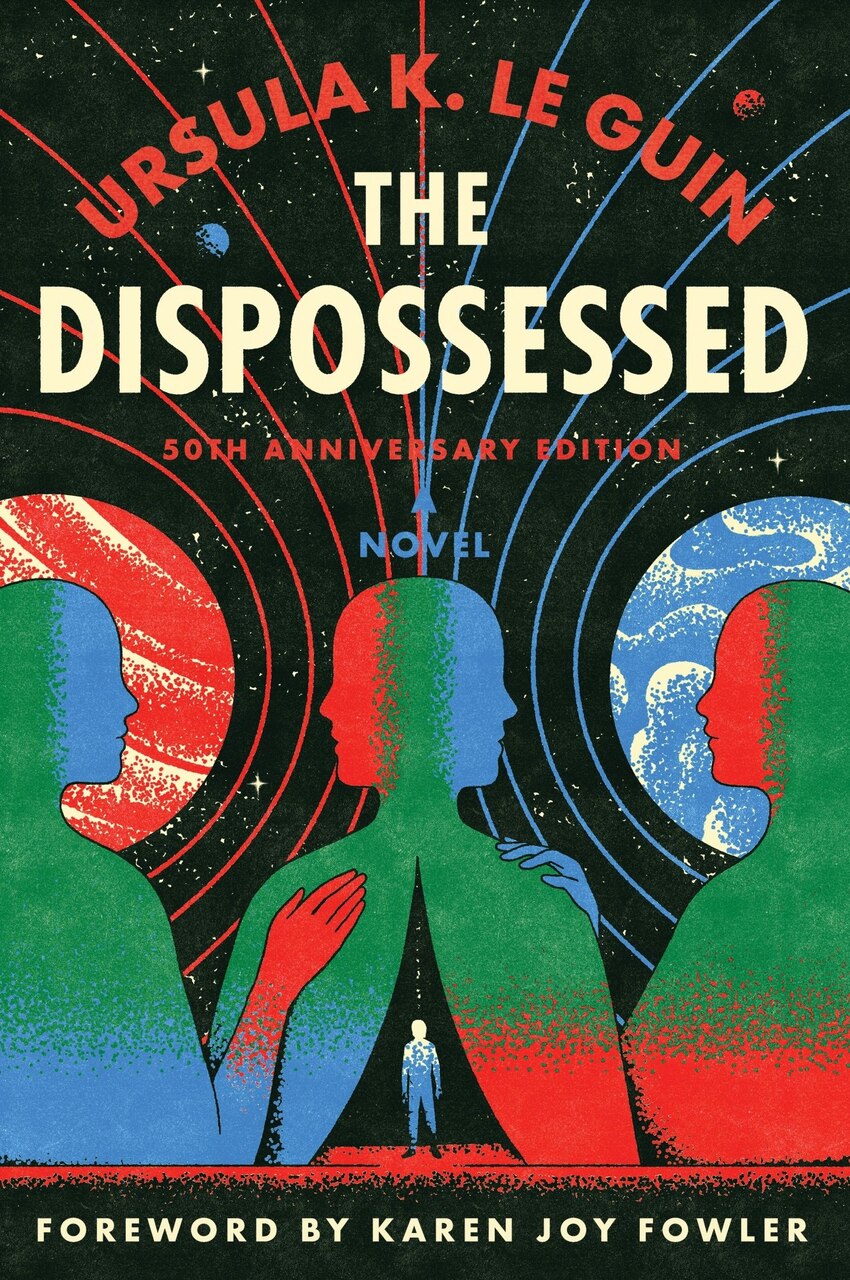
Wow, just wow. A truly great book. When I was first alerted to the existence of this book, it was basically sold to me as this, a book about capitalism, anarchism and feminism all wrapped up in a sci-fi novel. It sounded too ambitious, and in a sense I think they oversold it a little bit? At least on the feminism end. Even still, this novel was fantastic. My copy (whose cover is the image for this review), was 360 pages, but I basically split it into like three chunks of 120 pages. By the end I was just savouring the last 40 pages, leaving them for the right moment because I knew it would fly by, far faster than any book has really done for me in a while. Let's talk about it.
In fact, let me deconstruct the descriptor I remember seeing online when it came to this book, and break it down piece by piece. I would say most definitely this book is sort of about capitalistic and anarchist societies first and foremost. It does this job excellently by the way. I'm not saying this novel will magically turn you into an anarchist, but it's nice to see these societies be put into practice. If you have no interest in learning about new kinds of societies you will probably get significantly less milage out of this book than I did, but I thought it was fantastic.
This book is really two stories intertwined, following the same character, Shevek, through two timelines. One is the present, and one is a series of tableaus in his past leading up to the very beginning of other timeline. The present is set in Urras, the much wealthier, larger, capitalistic world, while Annarres, the sister planet that houses the much smaller, more desolate nation. It alternates chapter by chapter, and follows Shevek as he visits Urras with the hope of reunification, that in some shape or form he can help bring some good to the world.
For the first 60% or so of the book, Le Guin does quite a good job of showing the two systems and their pro's and cons. It doesn't outright try to tell you which one is better. I mean Shevek is quite surprised at the wealth or "the excess" as he likes to call it of Urras, but he seems to enjoy it. There are so few comforts and luxuries he's afforded at home, all the Odonians are so conscious of others, they don't even use what they perceive to be words that signify ownership. But slowly but surely Guin strips it away. The entire time Shevek is not allowed to even be with anyone who is not part of the "owner-class" as he puts it. He's highly monitored and he finally realizes the only reason he's there is so they can extract from him this theory that will hopefully provide them with dominance over the rest of the human planets.
Even then Annarres is no utopia either. The book literally starts with people protesting that Shevek is even deigning to leave. One of Shevek's first encounters is him being amazed at all of this running water and the live animals and colourful plants Urras has. Frankly, it's a testament to their mindset that they've managed to live so long on that desert planet. It's not perfect, Shevek talks about how he has one friend who was basically forced into an asylum, and how even in a system where there is no government people still find ways to exercise control and soft power over others.
Even still, by the end he's still itching to go home. It's a compelling way to showcase the two sort of ways of life. I mean would it have been cool to see Odonian way of life on a planet that was not completely devoid of life and in which you basically had to fight to live? Of course, but also there's simply no way the Urras would have given that to them, in fact the only reason they still talk is to mine precious metals. Would Urras have been that bad if they didn't shoot dissidents? It wouldn't be too far off from our own world I suppose.
Even still, by the end he's still itching to go home. It's a compelling way to showcase the two sort of ways of life. I mean would it have been cool to see Odonian way of life on a planet that was not completely devoid of life and in which you basically had to fight to live? Of course, but also there's simply no way the Urras would have given that to them, in fact the only reason they still talk is to mine precious metals. Would Urras have been that bad if they didn't shoot dissidents? It wouldn't be too far off from our own world I suppose.
Which brings me to my next point. You can kind of feel the age in this book. It's not neccesarily a bad thing, I don't think it's aged poorly, but respectfully this does feel like a book written from the 70's. It's supposed to be set in some alternate future where humans have the ability to travel through space, except when they describe the rich in Urras it basically sounds exactly like any other wealthy nation in our country now. It's less sci-fi/futuristic than it is like near-future except the only difference is that there are multiple human nations. It's even realistic in the fact that it still takes very long periods of time for people to travel as seen by the Terra ambassador and her conversations with Shevek.
Even Annarres seems almost backwater. I mean Shevek is so smart yet he writes largely on paper. There's absolutely nothing futuristic about them, except maybe the Odonian way of life and the computer that decides everyone's postings. Which relates to the point about feminism. I can't believe I'm saying this but it's sort of like the Barbie movie in the sense that I (a man by the way), feel as if any sort of feministic takeaway feels a little surface level. Like if anything Anarres is only progressive to you if you lived during the 70's, which is what the society of Urras feels like (I'm assuming how women felt back then. I'm not saying we don't have issues with sexism in our society, far from it, but it's usually much more cultural or systemic than literal laws at least where I'm from so it falls a bit flat in that regard.
Even still, an endlessly fascinating book that I just devoured. It's just so rare for me to really see an anarchist society in play, and see Guin play out the sort of natural consequences of it, even if she did put it in the most unforgiving environments. I suppose that was sort of the message, through Odonism, or some form of it, humans can still survive even the harshest climates. On the note of Shevek's sexual assault. I suppose it achieved it's purpose, it made me so deeply uncomfortable, and thematically it makes sense. It was like giving a child unlimited candy, at the first taste of free-flowing alcohol Shevek immediately tries to violate someone, almost take ownership of them. And then of course he wakes up in some deep shame, scott-free of course, because that is the society he is currently living in, and he has so much shame he gives it all up to return to his roots.
Final Score: 85/100
I hate to admit it but Guin's got some real sauce with this book. Which I guess is funny to say since I literally read the 50th anniversary edition, people have known this for quite some time. Even still, for a book this old, a sci-fi one it still felt quite fresh. The idea of an anarchist society, even if its world wasn't as sci-fi as it ought to be to me, was still a great read. I've already booked some of her earlier works in the Hainish cycle so I hope to be going through those for the rest of the year. I don't think she's George R. R. Martin to me yet but who knows, maybe I like her other work even more.


Comments
Post a Comment